


The loneliness epidemic
Loneliness and social isolation don’t just break hearts. Find out why social disconnection is a modern day disease epidemic and what we can do about it

By Rob Verkerk PhD, founder, executive & scientific director
The 450 million citizens living across the European Union’s single market all have one thing in common: they eat food. That’s why the EU’s new law on gene-edited crops is something we should all be talking about around the dinner table.
For more than two decades, European citizens fought hard to secure mandatory labelling of foods containing genetically modified organisms (GMOs). Whether people welcomed or rejected GM technology, they retained one fundamental right: the right to know. And guess what? Once they knew, they rejected. That’s got to be one of the biggest reasons Big Biotech was motivated to bulldoze new EU rules through the Council and EU Parliament that will allow certain types of NGT foods to enter the food supply without consumers being informed.

"Science should never be used selectively to justify more regulation where it suits policymakers and less regulation where it serves commercial or political objectives."
— Rob Verkerk PhD
The science of genetic engineering has moved on apace from the early days of GMOs. Some of the most powerful industrial forces on the planet have managed to persuade not only the unelected European Commission, but also the elected representatives of the European people within the European Parliament, that foods including plant ingredients created using gene-editing techniques that could occur by natural means don’t need to undergo safety or environmental testing before being placed on the market. And as I mentioned, they also don’t need to be labelled as such.
European consumers are simply meant to lay their trust in the European Commission and its agencies, both which have been variously accused of conflicts of interest, lack of transparency and even some instances of corruption.
This sea change in the EU’s approach to genetic engineering is driven by a new regulation that has just been approved—some would say rubber stamped—by the European Parliament and Council. It presently affects only plants (not animals or microbes) produced using certain New Genomic Techniques (NGTs). The legislation creates two categories of gene-edited plants. Category 1 plants — those deemed equivalent to plants that could theoretically have arisen through conventional breeding or spontaneous mutation in nature — will no longer be subject to the full GMO authorisation process. Category 2 plants, involving more complex changes, will remain under a modified version of the existing GMO regime.
This isn’t complete deregulation of Category 1 crops. Category 1 plants must still pass through a verification process of sorts. But it’s a major regulatory relaxation. Once verified, they will be treated much like conventionally bred plants. Final foods will not require GMO-style labelling, leaving consumers unable to know whether many ingredients have been produced using modern gene-editing techniques—or not. Bye, bye, informed choice.
Since 2002, the EU’s General Food Law Regulation has embedded the precautionary principle into food law (Article 7, Regulation 178/2002; see extract below). In simple terms, it allows protective measures where scientific uncertainty exists over possible risks to human health or the environment. Article 8 outlines consumer protection rules for foods in the EU. Check out the text below and decide if you agree that a consumer that found themselves eating a food they thought was entirely natural would have been misled if it was actually produced using a new genomic technique when this had not been stated on the label.
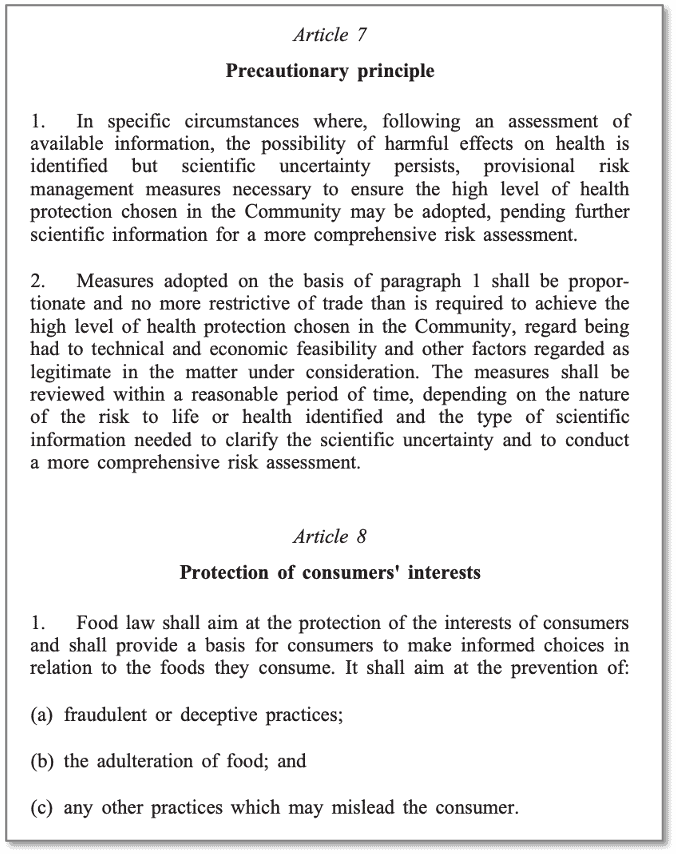
When you put Article 7(1) together with Article 8(1)(c) (see text above), do you feel that the EU might be bending its own rules to pull this off? At ANH, we do.
ANH has never opposed precaution per se. In fact, quite the opposite. We’ve spent more than two decades arguing for its scientifically coherent application.
That’s precisely why we have challenged the European Commission’s attempts to use the precautionary principle to justify driving maximum permitted levels for vitamins and minerals down to unnecessarily low amounts. In two peer-reviewed papers I published in Toxicology in 2010 (here and here), I demonstrated why such approaches were not based on realistic assessments of risk, which also included risks that would occur through the denial of benefit if highly restrictive, harmonised maximum levels were applied as planned. As we hear the European Commission is now gearing up to issue its proposal on maximum (and minimum) levels of vitamins and minerals, we are now preparing to submit a new risk-benefit framework that offers a more scientific way of assessing nutrients — one that considers both potential hazards and demonstrated benefits.
Taken together, that history makes the EU’s new NGT regime all the more striking.
When precaution is used to restrict nutrients with long histories of safe use, EU regulators often appear to demand extremely conservative assumptions. Yet when dealing with gene-edited plants, where legitimate scientific uncertainties remain, the same regulatory system now appears willing to assume that certain engineered genomic changes are sufficiently equivalent to nature to avoid full pre-market GMO assessment.
This raises a vital question: has the precautionary principle remained a scientific principle, or has it become a policy instrument that expands or contracts depending on prevailing arbitrary political and commercial priorities?
The Commission’s argument is superficially quite plausible:
Modern gene-editing tools, including CRISPR-Cas systems, can make very small, targeted changes to DNA. Some changes may involve only a single nucleotide. Similar mutations occur naturally, or through conventional breeding, and plants generated by older mutagenesis techniques have long entered the food chain without GMO-style regulation.
Therefore, the argument goes, it is disproportionate to regulate all gene-edited plants as GMOs.
But this is only part of the scientific picture, a scientific picture that is still opaque, rather than crystal clear.
Biology has repeatedly taught us humility. Every decade reveals new layers of complexity of biological organisation and operation that were scarcely imagined the decade before—from epigenetics and chromatin architecture to the emerging field of quantum biology. Scientific certainty has a habit of retreating just as quickly as scientific knowledge advances.
The more we learn about genome regulation, the more we appreciate that DNA sequence alone is only one part of an extraordinarily complex and interactive regulatory system. Rather than diminishing uncertainty, these discoveries remind us how much remains to be understood about the downstream consequences of even apparently modest genomic changes.
Therefore the issue we should try to grapple with is not simply whether the intended edit occurred. It is whether the biological consequences of that edit have been adequately understood. Logically: if the mechanisms that drive gene regulation are still only partly understood they must—by definition—be associated with a degree of uncertainty.
And that is exactly the kind of uncertainty the precautionary principle was designed to handle.
Another question seems to have largely escaped the airwaves that have provided limited coverage of the EU’s recent sleight of hand on GMOv2 aka NGTs: Who decides whether a plant enters Category 1 or Category 2?
Developers submit information showing that their plant meets the Category 1 criteria. Competent authorities then verify whether the criteria are satisfied, after which the European Commission may adopt the relevant implementing decision. EFSA may provide scientific input where required, especially for more complex cases.
In other words, the critical decision determining whether a product avoids full GMO-style assessment happens before that full assessment ever takes place.
Most applications may be straightforward. But where the boundary between Category 1 and Category 2 becomes fuzzy, public trust will depend on transparency, independence and the absence of undue industry influence.
Although the new NGT Regulation has now cleared the main EU legislative hurdles, it won’t apply immediately. The rules were proposed originally in 2023, have now passed through the Council of Ministers (of all 27 EU member states) and will enter into force 20 days after publication in the EU’s Official Journal. At the time of writing, publication in the Official Journal has yet to occur. It will then apply two years after coming into force.
This timeline creates a narrow legal window for challenge. Any direct challenge to the Regulation itself would generally need to be brought before the EU courts within two months of publication or notification, rather than waiting until the law is being applied in practice. Later challenges may still be possible against implementing decisions or specific regulatory acts, but the core Regulation will be much harder to attack once that initial window has closed.
There is something of a post-Brexit irony. The UK’s Genetic Technology (Precision Breeding) Act 2023 passed under the last Tory government of Boris Johnson created a more permissive route for precision-bred plants and animals in England than that for GMOs. Yet food and feed produced from precision-bred organisms still require specific authorisation before entering the market.
This means the EU’s Category 1 route may now actually be lighter than the UK’s for comparable plant products. Get that!
It also creates a real dilemma for cross-channel trade. If the UK wants reduced friction in food and agricultural trade with the EU, will it face pressure to dilute its own authorisation requirements? Or will the UK retain a more transparent system than the EU?
If you’re a health-conscious consumer, the answer to that question should be of real significance to you.
This debate is no longer just about biotechnology. It’s about informed choice.
Consumers cannot choose to avoid gene-edited ingredients if they cannot identify them. Farmers cannot protect supply chains without reliable traceability. Retailers cannot reassure customers unless they know what they are sourcing.
There are also broader concerns. Easier market access for gene-edited crops may accelerate consolidation of seed ownership—think how Monsanto used GM seeds and RoundUp to trap farmers in an unsustainable cycle. The unhindered flourishing of NGTs may increase agricultural dependence on proprietary breeding platforms and further concentrate control of agricultural genetics in the hands of relatively few multinational companies.
Supporters argue NGTs hold promise for producing crops that are better able to withstand climate stress, pests and disease. At the moment that’s a pipe dream more than a proven reality.
We also support innovation—but not when it comes at the expense of transparency and risk of unintended consequences.
Please don’t forget that consumers still have power!
Following are some of the things you can do regardless of what governments, their agencies and regulators try to do:
The question is no longer whether humans can edit genomes. We clearly can. The real question is who decides what level of uncertainty society should accept — and whether consumers retain the right to make that choice for themselves.
Science should never be used selectively to justify more regulation where it suits policymakers and less regulation where it serves commercial or political objectives. Whether we are talking about nutrients, natural medicines or gene-edited foods, the principles should remain the same: regulation must be proportionate, science-based, transparent and respectful of the public’s right to informed choice.
>>> If you’re not already signed up for the ANH International weekly newsletter, sign up for free now using the SUBSCRIBE button at the top of our website – or better still – become a Pathfinder member and join the ANH-Intl tribe to enjoy benefits unique to our members.
>> Feel free to republish – just follow our Alliance for Natural Health International Re-publishing Guidelines
>>> Return to ANH International homepage
Loneliness and social isolation don’t just break hearts. Find out why social disconnection is a modern day disease epidemic and what we can do about it

Our weekly roundup of the latest natural news from across the globe in one place. This week: Big tobacco & UPFs; Regenerative greenwashing; EU deregulates gene-editing; Needles, not pills; Plus updates from ANH-USA and much more…

Upcoming events, conferences, available courses and replays.
China is rapidly prioritising Alzheimer’s prevention as a major public health strategy, with an ageing population of 320 million over 60 and an estimated 20 million expected to be affected by 2030.
WhatsApp us