Where does your food come from?
The public at large is getting more and more interested in the origins of its food. But if that’s just the place or country of its origin – the provenance – that doesn’t tell us very much.
When you’re dealing with any plant food, there’s one thing that’s always critical to the health of the plant – and in turn – the health of the animals, including humans, that might feed on it. That’s down to whether the plant or crop has been grown in a living soil, loaded with organic matter and microorganisms!
Soil-less cultivation vs dead soils
The hard fact is that a great deal of the plant food bought in supermarkets is grown either without soil or in soils that have been heavily degraded.
That’s a problem when there’s an abundance of evidence that shows that healthy, living soils are a prerequisite for the production of healthy foods.
The two types of plant foods that you’ll commonly find that are often grown using soil-free cultivation are:
- Soil-less cultivation: Hydroponic salad leaves (bagged salads and baby leaves) and vegetables (e.g. tomatoes, sweet peppers, cucumbers). These crops are grown in soil-less, inert media such as perlite, vermiculite, clay pebbles or rockwool and are fed a nutrient solution.
- Degraded soils: Most farmland used for monocultures and industrial-scale agriculture that include high inputs of fertilizers and pesticides. That includes the majority of the non-organic cereals, starchy and non-starchy vegetables sold in supermarkets.
The benefits of living soils
As we understand more about plants, the more we understand the importance of a living soil, rich in organic matter and teaming with microorganisms. Plants have evolved alongside these microorganisms, that are in turn dependent on the organic matter, to not only gather the nutrients they need, they also use the microorganisms (especially fungi) for communication.
Think about it. As a plant, you’re not in a position to run from your enemies, be these plant eating insects, mites or nematodes. So you need to adapt to your sessile state – and that means being able to communicate to your neighbours and friends so they can initiate some chemical warfare (using plant ‘secondary metabolites’) and a ‘cry for help’ from friends that can protect you (e.g. parasitic wasps, hoverflies, ladybird beetles).
The kinds of environment that let plants do all of this best necessitate a healthy, living soil. They also shouldn’t be over-crowded, and they need enough water and sunlight to do the magic called photosynthesis that converts sunlight energy, carbon dioxide and water into chemical energy (carbohydrate/food), oxygen and water vapour.
What’s gone wrong with the soil?
Many things have caused soil to be severely degraded since industrial agriculture kicked off in earnest after WWII.
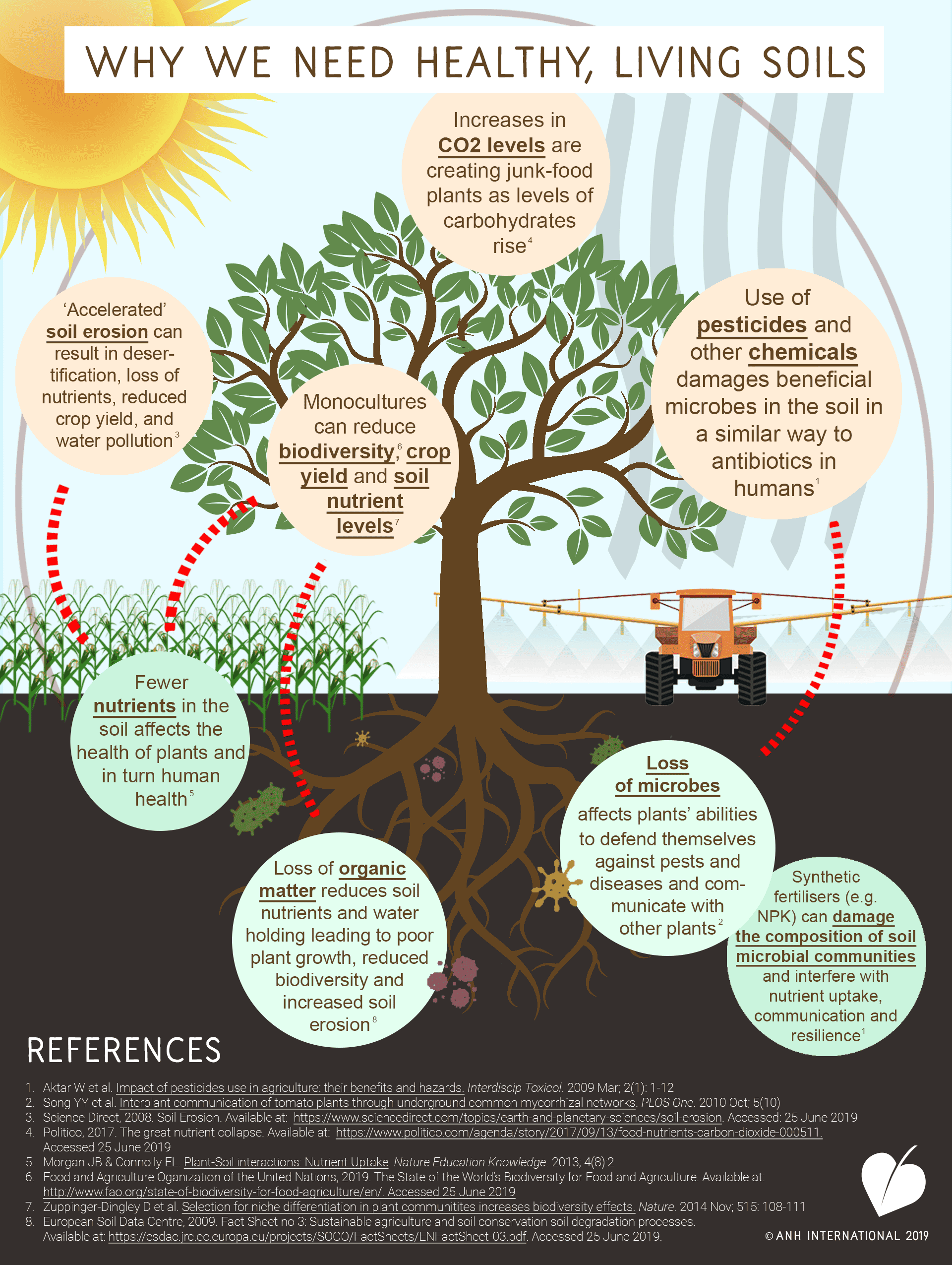
Our graphic below tells you about some of the most important processes that are disrupted when you don’t nurture the soil in which our crops grow.
Click on image to download linked PDF

Benefits of healthy, living soils
In short, this tiny layer of decomposing organic matter that covers 37.5% of the global land area is degrading so quickly because it’s value hasn’t been sufficiently recognised. Growing our plants in inert hydroponic media or on the moon won’t solve our problems. And if we’re going be concerned about rising CO2 levels in the atmosphere, we better develop a healthy regard for protecting both soils and our oceans. Both are incredibly important carbon sinks.
The Principle of Ecology is one of the core IFOAM principles for organic agriculture, stating: “Organic Agriculture should be based on living ecological systems and cycles, work with them, emulate them and help sustain them. In the case of crops this means that production should be based on the living soil.”
Here’s 6 stand-out benefits of living soils:
-
Important carbon sink that helps mitigate rising atmospheric CO2
-
Richer in organic matter and nutrients, allows better nutrient cycling
-
Healthier for humans and animals
-
Improved water conservation and resistance to drought
-
Better crop yields
-
Improved resistance to pests and diseases
How do we restore living soils?
Regenerative agriculture is the key. Organic agriculture done properly is regenerative, but some of the Big Ag players interpret organic agriculture as a kind of ‘free-from’ agriculture system that means they simply avoid adding synthetic fertilisers and pesticides. That won’t regenerate a soil. So much more is needed, such as adding or building organic matter (e.g. mulching, composting, cover crops), crop rotation, set-asides, and avoiding exposed bare soils.
All of this goes hand in hand with agro-ecological practices that are regenerative by nature. Food crops that come out of agro-ecological systems are less likely to be found in a supermarket and more likely to be found in local farm markets, at the farm gate, or through community-supported agriculture (CSA) or box schemes.
What can you do to support living soils?
It’s tough knowing how to eat responsibly – and it not having to cost the Earth (pun intended).
To ensure both planetary and human health, you could easily create a list of 30 or more things you should be looking for in the food you source.
But let’s make it easier. There are two massively important choices you can make that we think should top any list. If all of us did just these two things – we’d witness an agricultural revolution. Not only would this transform agriculture from an unsustainable system that may not be able to feed burgeoning human populations, it would also go a long way to staving off the damage humans have wreaked on the planet.
Here they are:
- Buy plant foods that have been grown in living soils. Avoid hydroponically grown salad veg grown in inert media. If you don’t know, ask the retailer. If they don’t know, look elsewhere. In 2021, the EU will prevent ‘organic’ claims on hydroponic veg.
- Opt where possible for plants (and animals) grown in or on soils that are part of an agro-ecological production system. Consider a weekly box scheme supplying local or regionally produced foods, farmers markets or buy direct from a farm shop if one is local to you. Community farming projects are also increasingly common – here’s one that’s local to us.
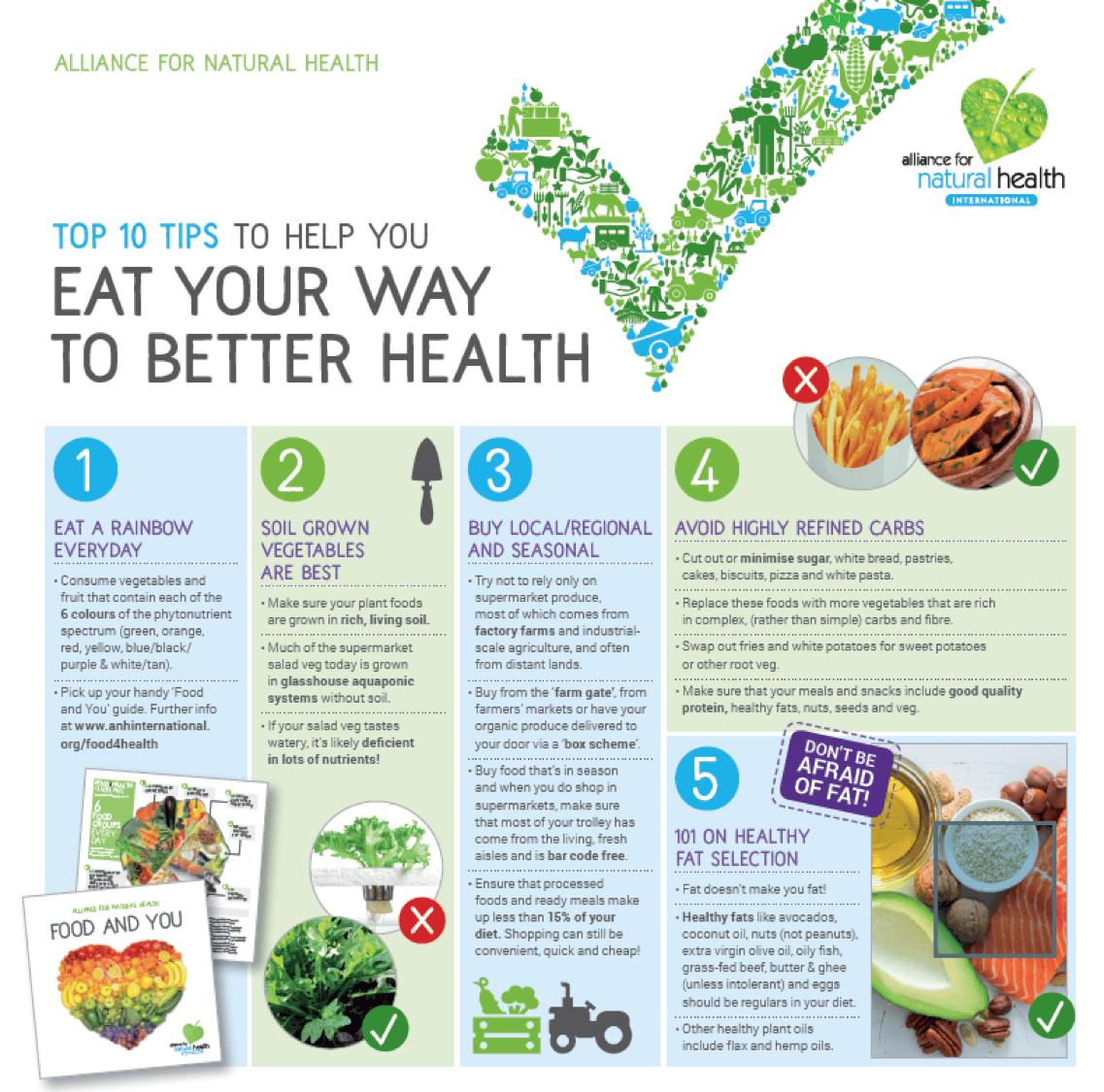
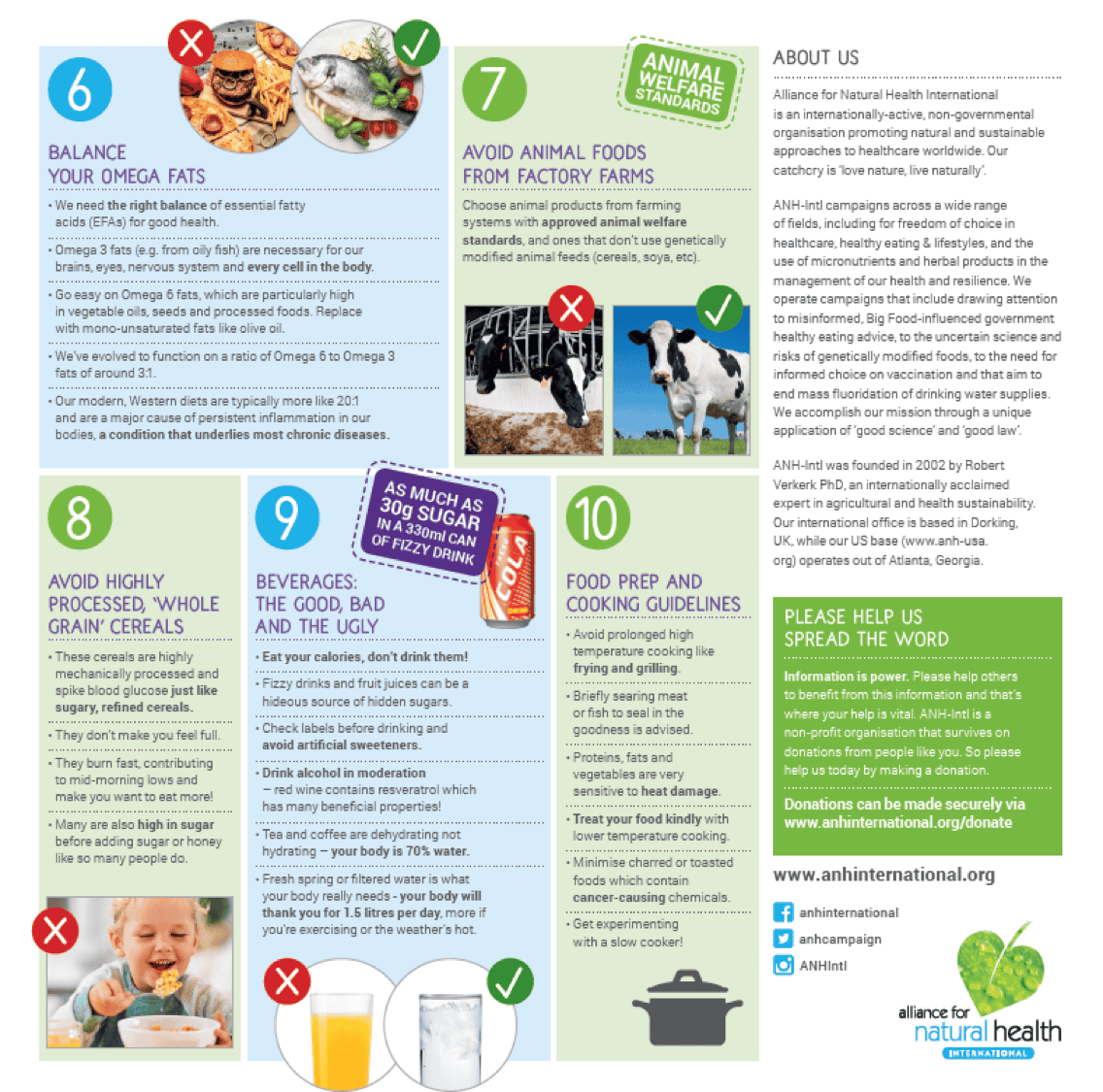
Download ANH Top 10 TIPS to Help You Eat Your Way to Better Health flyer







5 Responses
Here goes the alternative view.
Hi Robert. Love your commentary – and don’t find it contradicts many of the facts made in our article – it primarily adds more fodder and proposes an alternate solution. Fully agree with tree planting, and all work on agro-ecological farming systems supports diversification of both agricultural and neighbouring natural or semi-natural habitats, with tree and hedgerow planting being right up there. You’ve said swap out the arable farms for silviculture – that is agro-ecological farming in action. Making it happen in the next 5 years isn’t likely – over the next 30 it might be possible. Out article was about giving people something they can implement today or tomorrow – not in 3 decades time. We’ve referred to nutrient cycling as a general and important principle, you’ve given one example of it taken from natural forestry. Finally, we think it’s important to recognise that the science in all of these areas is inevitably complex as it incorporates scientific studies that reveal an incomplete understanding of the function of natural and semi-natural ecosystems impacted by humans and environments that are changing at incredibly rapid rates in evolutionary terms largely as a result of human interference. We therefore need to be careful about assuming that one fix (e.g. planting 3 trillion trees) will resolve so many problems. That doesn’t mean we shouldn’t aspire to unprecedented levels of tree planting – but such reforestation needs to be very carefully considered to ensure it is adapted to the region in question. Oil palm in SE Asia (introduced from W Africa in the mid-1800s) is one example of reforestation with a food-bearing tree that didn’t take into account agro-ecological principles. The solutions are in our view both more complex and complicated than you suggest, and nothing you’ve said in our view contradicts the essential tenets of our piece that proposes we promote the consumption of foods derived from healthy living soils and agro-ecological farming systems. We might just need to agree to differ on elements of detail, and we agree that in a topic as big as this there’s going to be huge amounts that don’t get discussed.
Good comment above – hearkens to my reading of Victor Schauberger – but the demonisation of CO2 is a signature of corporate deceit – as was butter, sat fats &etc. It works by guilt and fear to undermine Life.
Hi Brian – as in my comment to Robert, I agree with a lot of what you say. For example, I 100% agree the way in which big corporates and governments are handling the response to CO2 and GHGs is more down to how they can capitalise further from it, than trying to resolve the underlying problems that are as much related to habitat destruction and over-population by a single species, Homo sapiens. To deny there is an environmental crisis that is unprecedented since the Industrial Revolution that is caused largely by humans would be an odd position to take in my view, given our interpretation of available environmental science and ecological systems. Blaming all of the problems on excess atmospheric carbon and oceanic acidity (and hence an inability to buffer CO2) would be equally odd. Creating more balanced. agro-ecosystems, diversifying the vast land area that is currently used for agriculture, reinstating life to soils – and the other things we discussed in our article, still in our view remain accessible and realistic solutions to transitioning towards more stable ecological balance on our planet. You can find out more about our position on this In our report that was critical of both the nutritional and agricultural elements of the EAT-Lancet report released in January: https://www.anhinternational.org/news/anh-intl-special-report-analysis-of-the-eat-lancet-report/
Robert,